



Many businesses continue to wrestle with a fundamental IT question: should you pay only when something breaks, or invest in proactive, ongoing support? The debate remains relevant because IT costs continue to rise, and downtime is more expensive than ever.
System outages aren’t just technical hiccups. CIO Dive found outages drain $200 million annually per company, with $49 million tied directly to lost revenue. That’s potentially catastrophic.
As Patrick Cranston, President, Cranston IT, puts it: “The way you manage IT now will decide whether your business can compete tomorrow, because every outage, every delay, and every missed upgrade chips away at your edge.”
In this blog, we’ll break down the differences between break-fix and managed services, covering costs, risks, and long-term value. By the time you are done reading the blog, you’ll have a clear understanding of which model fits your business best, and how to invest in IT without overspending or risking downtime.
Stop Waiting for IT Failures to Hit You!Take control of your tech before it costs you downtime and revenue. Let us guide your switch to proactive IT. |
What Are Break-Fix Services?
Break-fix services represent the traditional, reactive model of IT support. You only engage a technician when something goes wrong—no contracts, no ongoing monitoring, and no guaranteed response times.
Here’s what businesses typically pay for under this model:
- Labor Fees: Billed hourly, often at premium rates for urgent issues
- Parts and Equipment: Replacement hardware or software is charged separately
- Time-to-Resolution: The longer the fix takes, the higher the final cost
This simplicity appeals to smaller companies. With fewer systems and limited budgets, paying only when you need help can seem cost-effective. A small office with a handful of workstations might find break-fix manageable.
But there’s a catch: There’s no Service-Level Agreement (SLA). That means no guaranteed availability, no defined recovery time, and no proactive support. If your server crashes during peak hours, the cost of lost productivity may far exceed the repair bill.
As IT environments grow more complex, the break-fix model becomes increasingly risky. It’s built on uncertainty, and in an economy that runs on 24/7 uptime, uncertainty is a liability.
What Are Managed IT Services?
Managed IT services offer a proactive, full-spectrum approach to technology support. Instead of reacting to failures, providers continuously monitor, maintain, and secure your systems, ensuring stability before issues arise.
For a predictable monthly fee, you gain access to comprehensive IT management backed by clear Service-Level Agreements (SLAs). This model shifts IT from a reactive cost center to a strategic asset.
Core elements of managed services include:
- Endpoint Monitoring and Management: Automated tools track desktops, servers, and networks for early warning signs, allowing providers to resolve issues before they disrupt operations.
- Help Desk Support: Round-the-clock technical assistance ensures your users get fast, reliable help whenever they need it.
- Cybersecurity Protection: Managed antivirus, patching, and vulnerability scanning reduce exposure to threats and keep systems secure.
- Backup and Disaster Recovery: Scheduled backups and tested recovery protocols protect your data and ensure business continuity in the face of disruptions.
Managed Service Providers (MSPs) use platforms such as Remote Monitoring and Management (RMM) and Professional Services Automation (PSA) to oversee multiple environments. These tools enable rapid response, streamlined workflows, and minimal downtime.
For businesses, the benefits are clear:
- Greater stability and uptime
- Predictable IT costs
- Stronger defenses against cyber risks
Break-Fix vs Managed Services: Which Side of Risk Are You On?
Choosing between break-fix and managed services is more than a cost debate. It’s about control, risk, and long-term resilience. Here’s how the two models compare across critical dimensions:
1. Payment Structure
- Break-Fix: Pay-per-incident, often billed per hour.
- Managed Services: Flat monthly fee covering monitoring, support, and strategic planning.
While break-fix may appear cheaper upfront, managed services deliver broader value through continuous support.
2. Costs
- Break-Fix: Favors short-term savings but spikes during major failures.
- Managed Services: Spreads costs evenly, reducing financial unpredictability.
CloudSecureTech reports that companies using managed services cut IT costs by 25% while boosting productivity by 45%.
3. Control and Responsibility
- Break-Fix: You decide when to act, placing the burden of IT decisions on your shoulders.
- Managed Services: Responsibility shifts to your provider, aligning both parties to maintain system health proactively.
4. Risk and Downtime
- Break-Fix: Accepts downtime as inevitable.
- Managed Services: Focuses on prevention, identifying issues before they disrupt operations, thereby keeping downtime costs significantly lower.
5. Support Levels
- Break-Fix: Limited support, often unavailable outside business hours.
- Managed Services: Typically includes 24/7 support, ensuring rapid response when it matters most.
Each difference underscores a key truth: reactive IT care can’t scale with modern business demands. As systems grow more complex and threats become more frequent, proactive support becomes non-negotiable.
| More articles you might like: |
Why Businesses are Breaking Up with Break-Fix Services
The break-fix model once fit the needs of simpler IT environments, such as offices with a few desktops and limited infrastructure. However, today’s business environments include cloud platforms, mobile workforces, and increasingly complex security demands. The “fix it when it breaks” approach simply can’t keep up.
Cyber threats are a driving force behind the shift. Cybersecurity research shows attacks on SMBs can drain anywhere from $25,000 to $3 million per incident. Businesses relying on break-fix often lack the layered, preventive defenses needed to withstand constant attacks.
There’s also a misalignment of incentives. Break-fix providers earn more when problems persist, charging for time, parts, and repeat visits. Managed service providers (MSPs), on the other hand, profit when systems stay stable, creating a shared goal of uptime and reliability.
For businesses that depend on operational continuity and customer trust, reactive support is no longer viable. The cost of downtime, data loss, and reputational damage far outweighs the savings of ad-hoc fixes.
Do Break-Fix Services Still Play a Role?
While its relevance is shrinking, break-fix still serves niche scenarios:
- Small businesses with minimal IT needs: A two-person shop using only email and basic accounting software may find break-fix cost-effective.
- Non-critical environments: Projects or departments where downtime carries little risk may prefer occasional support over full management.
- Supplemental IT support: Internal teams may use break-fix providers for overflow work or specialized one-off tasks.
Even in these cases, the model struggles to support long-term growth. It solves immediate problems but doesn’t build the scalable, resilient foundation modern businesses require.
Why Managed Services Are the Preferred Choice
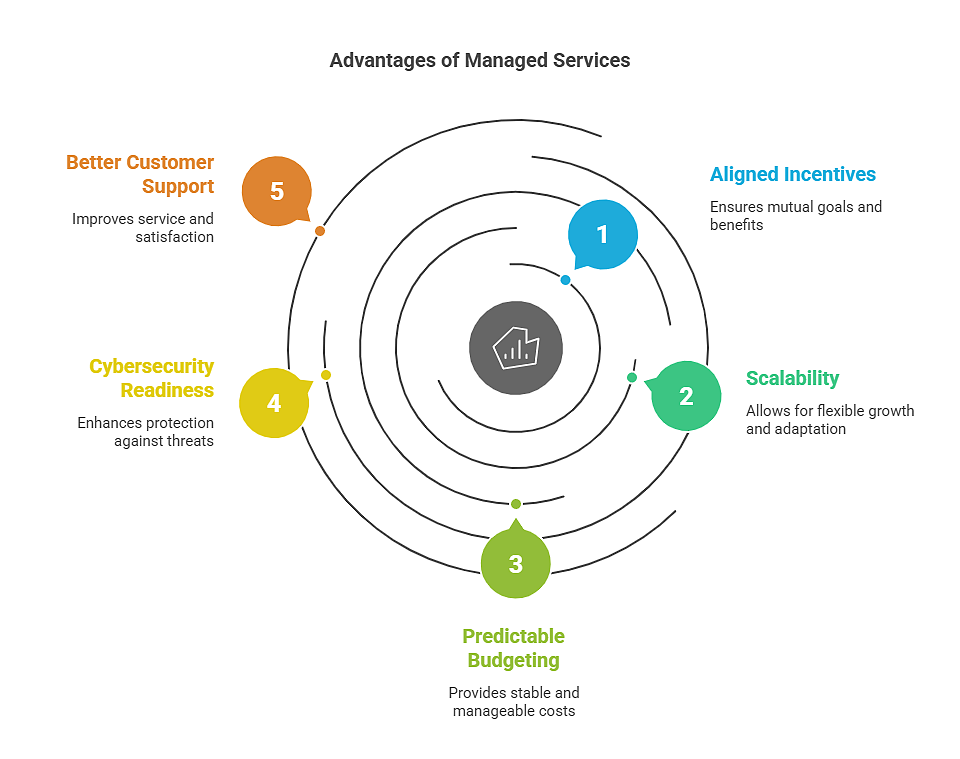
Managed services have become the dominant IT support model because they align with how modern businesses operate: fast-paced, digitally dependent, and risk-aware. The benefits go far beyond uptime.
Here’s why organizations are making the shift:
- Aligned Incentives: Managed service providers (MSPs) succeed when your systems stay healthy. Their business model rewards prevention.
- Scalability: As your business grows, managed services scale effortlessly, adding users, endpoints, and capabilities without disruption.
- Predictable Budgeting: Flat monthly fees eliminate surprise expenses, ranging from emergency fixes, making IT costs easier to forecast and control.
- Cybersecurity Readiness: Continuous monitoring, patching, and layered protection reduce vulnerabilities and strengthen your defense posture.
- Better Customer Support: Access to skilled help desk professionals ensures users get timely, expert assistance, often 24/7.
The proactive nature of managed services delivers value immediately and compounds over time. That’s why most organizations adopt this model as they grow and mature.
How to Transition from Break-Fix Services to Managed Services
Moving from reactive to proactive IT support doesn’t have to be disruptive. Here’s a practical roadmap many businesses follow:
- Evaluate Current IT Costs: Add up hardware expenses, downtime losses, emergency repair fees, and productivity hits. You’ll likely uncover more hidden costs than expected.
- Identify Gaps: Assess vulnerabilities in your current setup, especially around cybersecurity, disaster recovery, and scalability.
- Test Co-Managed Services: Start small with targeted MSP contracts, such as help desk support or patch management. This lets you experience the benefits without full commitment.
- Select the Right Partner: Choose an MSP with proven expertise, robust tools, and transparent SLAs. Look for a provider that understands your industry and business goals.
Transitioning often reveals inefficiencies already costing you under break-fix, costs that managed services absorb more effectively and predictably.
Choosing the Right IT Model for Your Business
Selecting the right IT support model isn’t just a technical decision. The choice between break-fix and managed services depends on your business’s size, goals, and risk profile.
Here are key factors to consider:
- Budget: Are you prepared for unpredictable spikes in IT costs, or do you prefer stable, monthly expenses that support long-term planning?
- Risk Tolerance: Can your business afford extended downtime, or do you need systems to stay online and secure around the clock?
- Internal Resources: Do you have in-house IT staff to manage issues, or do you rely entirely on external support?
- Compliance Needs: Are you subject to industry regulations that require secure, monitored systems and documented controls?
For most businesses, the break-fix and managed services debate isn’t binary; it’s a timeline. Break-fix may work in the earliest stages, when IT needs are minimal. But as operations grow, complexity increases, and the cost of downtime rises, managed services become the only sustainable option.
The Business Impact of Managed Services and Break-Fix Services
Every IT approach shapes your business in more ways than just tech performance. From daily workflows to strategic growth, the choice between break-fix services and managed services influences productivity, compliance, and innovation.
The following table breaks down these differences, showing the tangible impact each model has across critical business areas.
| Area of Impact | Break-Fix Services | Managed Services |
|---|---|---|
| Employee Productivity | Delays during downtime lower efficiency | Fewer disruptions improve daily workflows |
| Customer Satisfaction | Service interruptions affect client trust | Consistent uptime builds stronger trust |
| Strategic Planning | IT is reactive, no long-term roadmap | IT strategy supports business growth |
| Compliance Readiness | Minimal support for audits and standards | Continuous monitoring meets compliance needs |
| Innovation Potential | Budget tied up in emergencies | Stable IT allows room for innovation |
Break Free from Break-Fix and Build Stability with Cranston IT
Choosing between break-fix and managed services has much more to do with how you want your business to grow. While break-fix may suit limited, short-term needs, managed services offer the stability, security, and scalability modern organizations require.
At Cranston IT, we bring two decades of experience in proactive IT management. With an 11-minute average resolution time and a 6-minute response time, we empower businesses to operate with confidence and agility.
|
Explore Our IT Services in Pittsburgh |
Ready to rethink your IT strategy? Let Cranston IT guide you through a seamless transition. Contact us today to schedule your consultation and discover how managed services can future-proof your business.
